Volume 19, Issue 3 (September 2022)
Abstract
(25578 Views) |
Full-Text (PDF)
(9384 Downloads)
|
Graphical Abstract
|
Reseach Highlights
Graphical Abstract:

Reseach Highlights:
- The frictional behavior of a copper-free and low-met commercialize friction composites is investigated
- As substitutions for copper, ptoassim titanate platelet and ceramic fiber were used
- Ceramic fiber at elevated temperature improve thermal behavier
- Potassium titanate platelet act as high temperature modifier
- Synergetic effect of potassium titanate and ceramic fiber improve the fade and recovery properties
Abstract
(27154 Views) |
Full-Text (PDF)
(8350 Downloads)
|
Graphical Abstract
|
Reseach Highlights
Graphical Abstract:

Reseach Highlights:
- ZnO/Fe3O4 and TiO2/Fe3O4 nanocrystalline thin films were synthesized on a glass substrate by the casting method
- ZnO and TiO2 thin films were synthesized on a glass substrate by the chemical bath deposition method and Fe3O4 NPs solution by hydrothermal metoth and aultrasunicatur as an assistant of prepared.
- Photocatalytic activity of ZnO/Fe3O4 and TiO2/Fe3O4 nanostructure was investigated against methylene blue dye under irradiation visible light
- Photodegradation ratio of dye increased when irradiation time and basic medium were increased
Abstract
(24773 Views) |
Full-Text (PDF)
(7973 Downloads)
Abstract
(26079 Views) |
Full-Text (PDF)
(9340 Downloads)
|
Graphical Abstract
|
Reseach Highlights
Graphical Abstract:

Reseach Highlights:
- Al-doped LLZO solid electrolyte is successfully synthesized by using the combustion sol-gel technique
- The addition of Al dopant promotes the cubic phase by increasing the lithium vacancy concentration and destabilizing lithium in the tetragonal phase
- The addition of Al promotes LLZO sintering and increases the density of the LLZO sample.
- Li6.25Al0.25La3Zr2O12 showed the highest ionic conductivity at room temperature that can be a good candidate for solid electrolyte batteries.
Abstract
(27442 Views) |
Full-Text (PDF)
(8630 Downloads)
|
Graphical Abstract
|
Reseach Highlights
Graphical Abstract:

Reseach Highlights:
- Graphene-ZnO nanocomposite was synthesized by two methods.
- The photoluminescence properties of the ZnO-graphene nanocomposite were improved by using graphene.
- The graphene-zinc oxide nanocomposite synthesized by the direct method had higher photocatalytic power.
Abstract
(30979 Views) |
Full-Text (PDF)
(8122 Downloads)
|
Graphical Abstract
Graphical Abstract:

Abstract
(29176 Views) |
Full-Text (PDF)
(8504 Downloads)
|
Graphical Abstract
|
Reseach Highlights
Graphical Abstract:

Reseach Highlights:
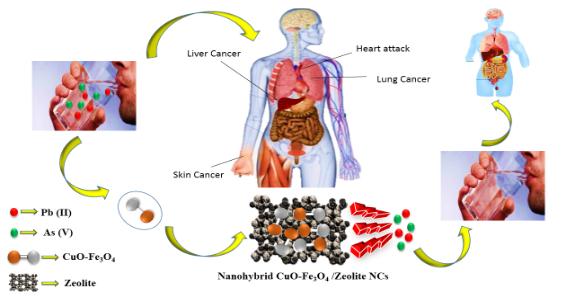
- Nanohybrid CuO-Fe3O4/Zeolite Nanocomposite as Potential Adsorbent for Toxic As (V) and Pb(II) from Water Solution.
- x wt.% Nanohybrid CuO-Fe3O4/Zeolite Nanocomposite showed small particles with sizes of 7.32- 11.78 nm nm for all x wt%-HCFZ NCs samples.
- 10-HCFZ NC sample showed the highest removal efficiency (97.9 %) for Pb cations (100 ppm) and (93.5 %) for As cations (100 ppm) within 30 minutes.
- The adsorption results showed that Nanohybrid CuO-Fe3O4/Zeolite NC catalysts were efficient and stable catalysts with promising adsorption capacity for environmentally unfriendly metallic pollutants.
Abstract
(35515 Views) |
Full-Text (PDF)
(8486 Downloads)
|
Graphical Abstract
|
Reseach Highlights
Graphical Abstract:

Reseach Highlights:
- Hydrophobic silica nanoparticles were synthesized by sol-gel method.
- Without using any heat treatment a stable hydrophobic and self-cleaning coating was applied.
- The installed insulators operating in power lines can be coated without being removed from the circuit and without the need to cut off power.
Abstract
(23323 Views) |
Full-Text (PDF)
(8114 Downloads)
|
Graphical Abstract
|
Reseach Highlights
Graphical Abstract:

Reseach Highlights:
1. According to XRD examination, the widening of the diffraction pattern could very well be attributable to the increase in the duration of milling from 0 to 20 hours, showing that perhaps the nano-crystalline state had been established as a result of HEBM. The emergence of MgZn2 precipitates due to the combined application of heat and pressure was validated by XRD examination.
2. The relative density was inversely proportional to the increase in milling time which reduced the particle size from 0 to 49 nm after 20 h of milling of the base powders.
3. Owing to the precipitation hardening phenomena, the microhardness of all the specimens steadily enhanced after 3, 6, 12, and 24 hours of artificial ageing at 115°C. Peakage hardness was attained at 24 h of ageing, beyond which the microhardness (VHN) of all the specimens, regardless of particle size, began to decline. Overageing occurred after 96 h of ageing.
4. When compared to the other specimens, the T6 treated Al 7150 alloy made of milled powders of 49 nm size showed a superior microhardness of 255 VHN. This is due to the particle size reduction due to increasing the duration of milling as well as close packing of the powders under the influence of the simultaneous application of pressure and heat during hot pressing.
5. Pin on disc wear testing conducted under varying loads and sliding speeds showed the beneficial effect of artificial ageing in enhancing the wear behavior of the T6 treated samples.
6. The capacity of the T6 specimens to withstand the dry sliding wear loads throughout pin-on-disc wear testing can be attributed to the development of (MgZn2) precipitates, which slowed dislocation movements.
7. The T6 sample’s HRTEM microstructure showed a high density of MgZn2 precipitates dispersed evenly in the Al 7150 alloy matrix, the precipitates comprising of the metastable η′ phase, with lesser amounts of GP zones and the stable η phase were observed.
8. FESEM morphology revealed extensive damage on the wear specimen’s surface due to severe plastic deformation during wear testing, indicating poor wear resistance of the non-aged samples. A mixture of adhesive, delamination and abrasive wear modes was identified during FESEM analysis.
9. The current study concludes that by optimizing the process parameters such as milling time, ageing as well as reducing the particle size of the base powders, the hardness and wear behavior of Al 7150 alloy may be improved.
Abstract
(31256 Views) |
Full-Text (PDF)
(7874 Downloads)
|
Graphical Abstract
|
Reseach Highlights
Graphical Abstract:

Reseach Highlights:
- Nanocomposites of TiO2/MgO have been successfully prepared by pulsed laser deposition technique with different number of pules for laser.
- Increasing the number of laser pulses led to an increase in the size of the prepared particles.
- The surface roughness of the prepared TiO2/MgO Nano films increased due to the increase in the number of laser pulses.
- led to an increase in no. of laser pulse to an increase in absorbency. Thus, the energy gap of the prepared films is reduced.
Abstract
(26655 Views) |
Full-Text (PDF)
(15197 Downloads)
Abstract
(21605 Views) |
Full-Text (PDF)
(13905 Downloads)
Export as:
HTML
|
XML
|
RSS